The phone rang on a Sunday evening, a call from Stuttgart. Her mother was seventy-eight and lived in Pendik. At a holiday meal, while she was eating stuffed vine leaves, her lower denture had come loose. She said nothing, wrapped it in a napkin, put it in her handbag and had only soup for the rest of the meal. Her daughter found out three days later, from her brother.
"Doctor, is it even possible at that age? Or are we just going to wear her out for nothing?"
We hear this a lot. When people ask about the age limit for dental implants, the first thing I say is that we do not decide by the number on an ID card. What we look at is the bone, the medicines being taken, general health such as the heart and blood sugar, and how that person will be able to clean their mouth over the coming years. Some people are excellent candidates at seventy-five, and some we ask to wait a little at fifty-five.
Is there an age limit for dental implants?
The short answer is that there is no upper age limit.
Neither in Turkey nor anywhere else is there a written maximum age for implants. People in their eighties receive them. We have also placed two implants in the lower jaw of someone who had passed ninety, to hold their denture steady.
We do not have to guess here, because it has been studied. A large systematic review that pooled the effect of advanced age and common general illnesses on implants found that implants in older people stay in the bone about as long as those in younger people. In other words, age alone is not treated as an obstacle.
But let me be honest. Age does change a few things. Healing can be a little slower, the medication list gets longer, dexterity and eyesight decline, and sometimes memory comes into it. None of these is enough on its own to say no, but they change the plan. We do not draw up the same plan for someone of forty and someone of seventy.
We explain the general process on our dental implant treatment page. Here I will only deal with the parts that change in later life.
What is the minimum age for dental implants?
There is no upper limit, but there is a lower age limit, and people often mix the two up.
Implants are not placed before the jawbone has finished growing. The reason is simple. A natural tooth moves along with the bone, while an implant does not. An implant placed while growth continues can end up lagging behind the neighbouring teeth a few years later, and when the person smiles, one tooth looks sunken. It is usually accepted from around 16-18 in girls and a little later in boys, and the final decision comes from the X-ray.
So "is it too late?" is a meaningful question for teenagers, not for older adults.
Do dental implants work for elderly people, and what happens to bone with age?
Many people assume bone simply disappears with age. That is not quite right. What really wears the jawbone down is not age but missing teeth and the denture that sits on top of them for years. Once the root is gone, the bone no longer receives chewing forces, and the body slowly pulls back bone it has no use for. This is more obvious in the lower jaw. Someone who has worn a denture for twenty years can have a lower jaw as thin as a ruler.
When planning dental implants for elderly patients, we give the bone a little more time. We do not rush. An implant we might load a few weeks earlier in a younger person, we may prefer to leave longer in someone past seventy. The reason is not that the bone will not hold, but that the bone may take longer to wrap around the implant.
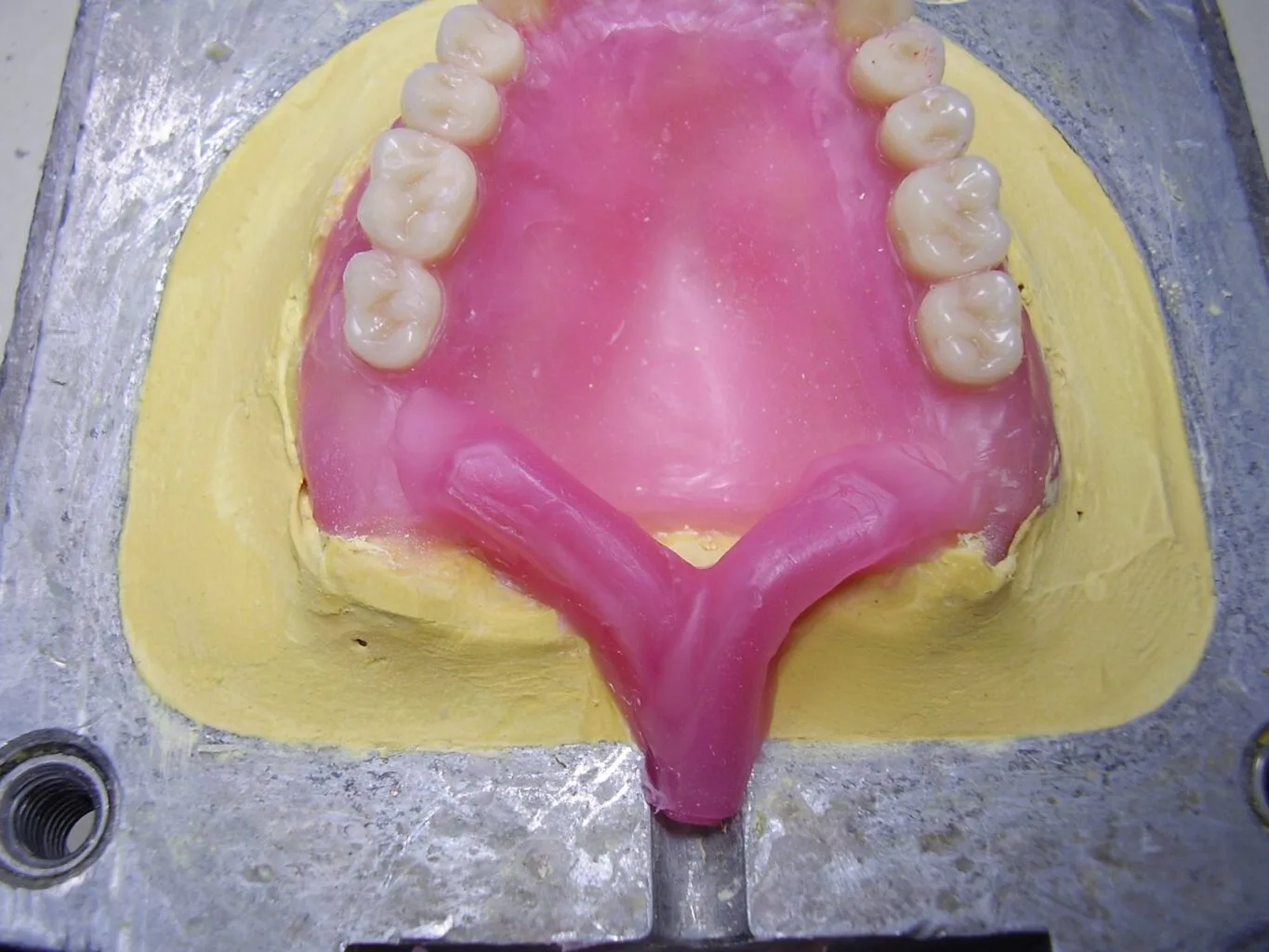
Bone quality matters too. The front of the lower jaw is usually hard and dense, a very forgiving place for an implant. The back of the upper jaw is more like a sponge, and there we take extra care. This difference exists in young people as well, but it becomes more pronounced with age.
Can you get dental implants if your dentures are loose?
Yes. In fact, this is the most common reason older people ask about implants, a lower denture that has been lifting at meals for years, clicking when they talk, and leaving them with nothing but soup at the table.
Upper and lower dentures do not bother people equally, and most patients notice this themselves. An upper denture sticks to the palate by suction and sits on a wide surface. A lower denture has only a narrow ridge of bone to sit on, and the tongue and cheeks keep pushing it. The denture that lifts at meals, rattles when you speak and collects seeds underneath is almost always the lower one.
"I use the adhesive cream, Doctor, it lasts until lunchtime and then it is the same again."
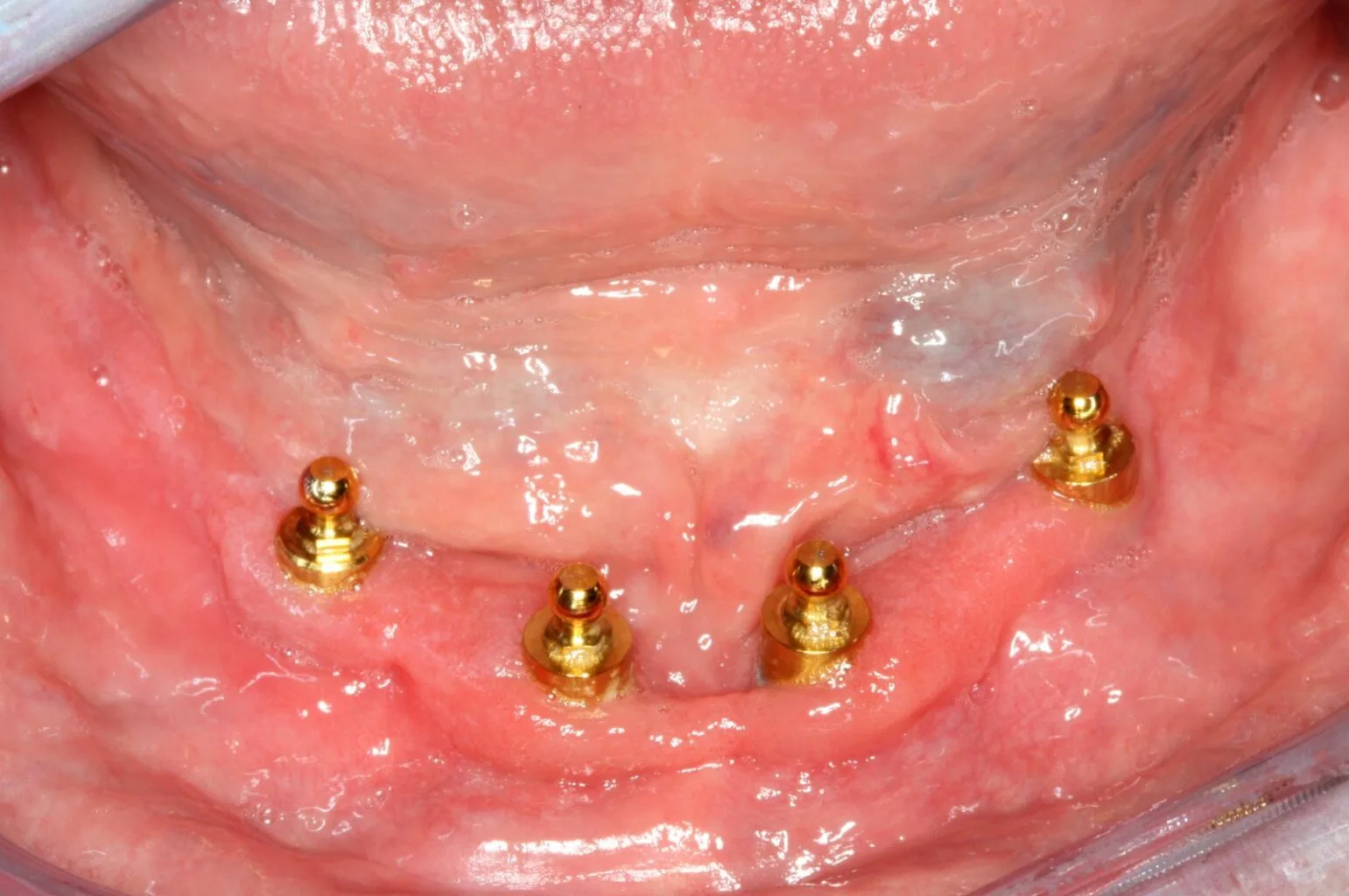
Cream gets you by. It does not solve the problem. Implants for loose dentures usually come in at this point. We place a few implants in the lower jaw, and the denture clips onto them with small attachments that snap on and off. With an upper denture that covers the palate there are fewer complaints, so starting with the lower jaw alone is sometimes enough.
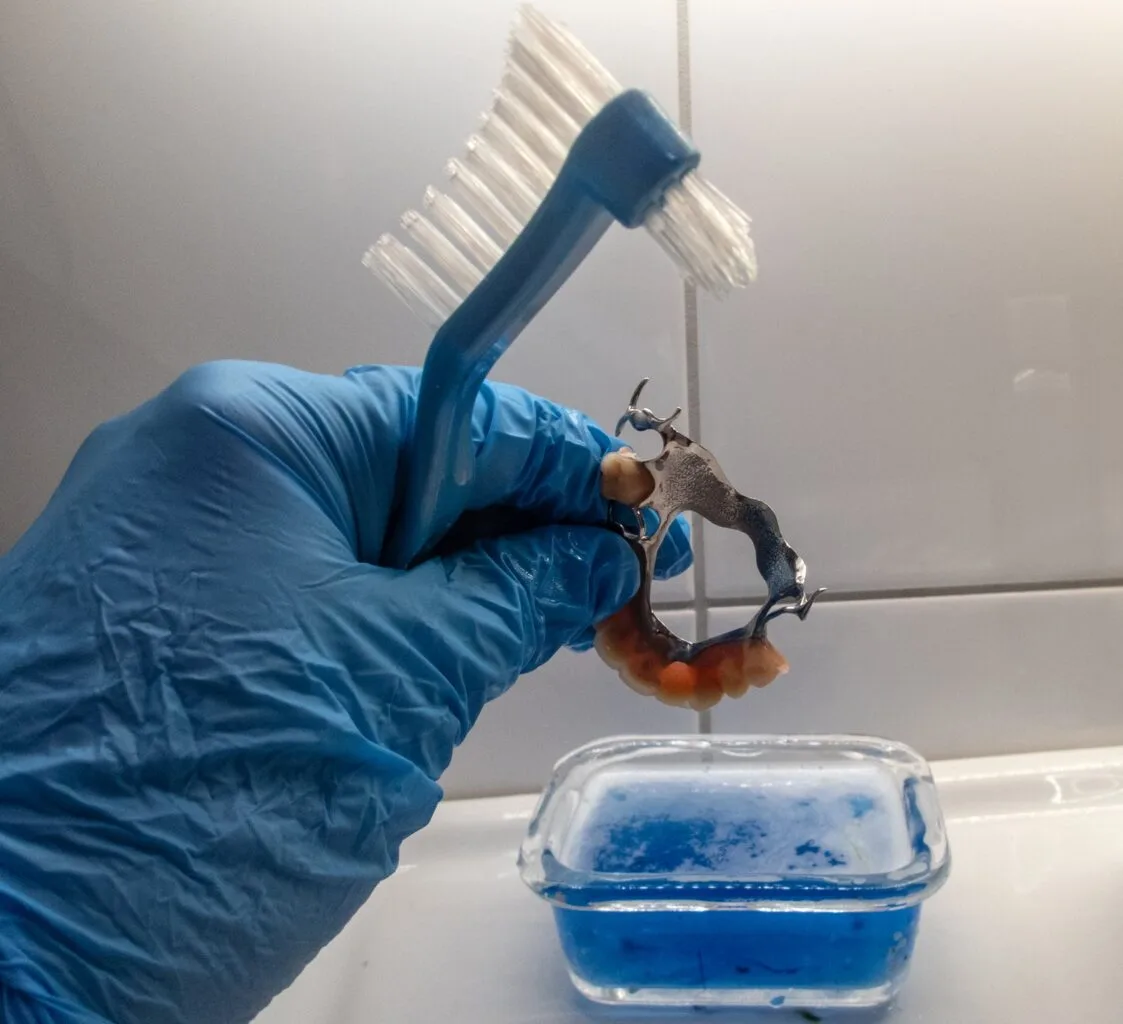
As the NHS guide to dentures explains, a denture should be taken out and cleaned at night. That habit does not change with an implant-supported denture, it just stops moving around during the day. Raise this at the start, because some families hear the word implant and picture fixed teeth.
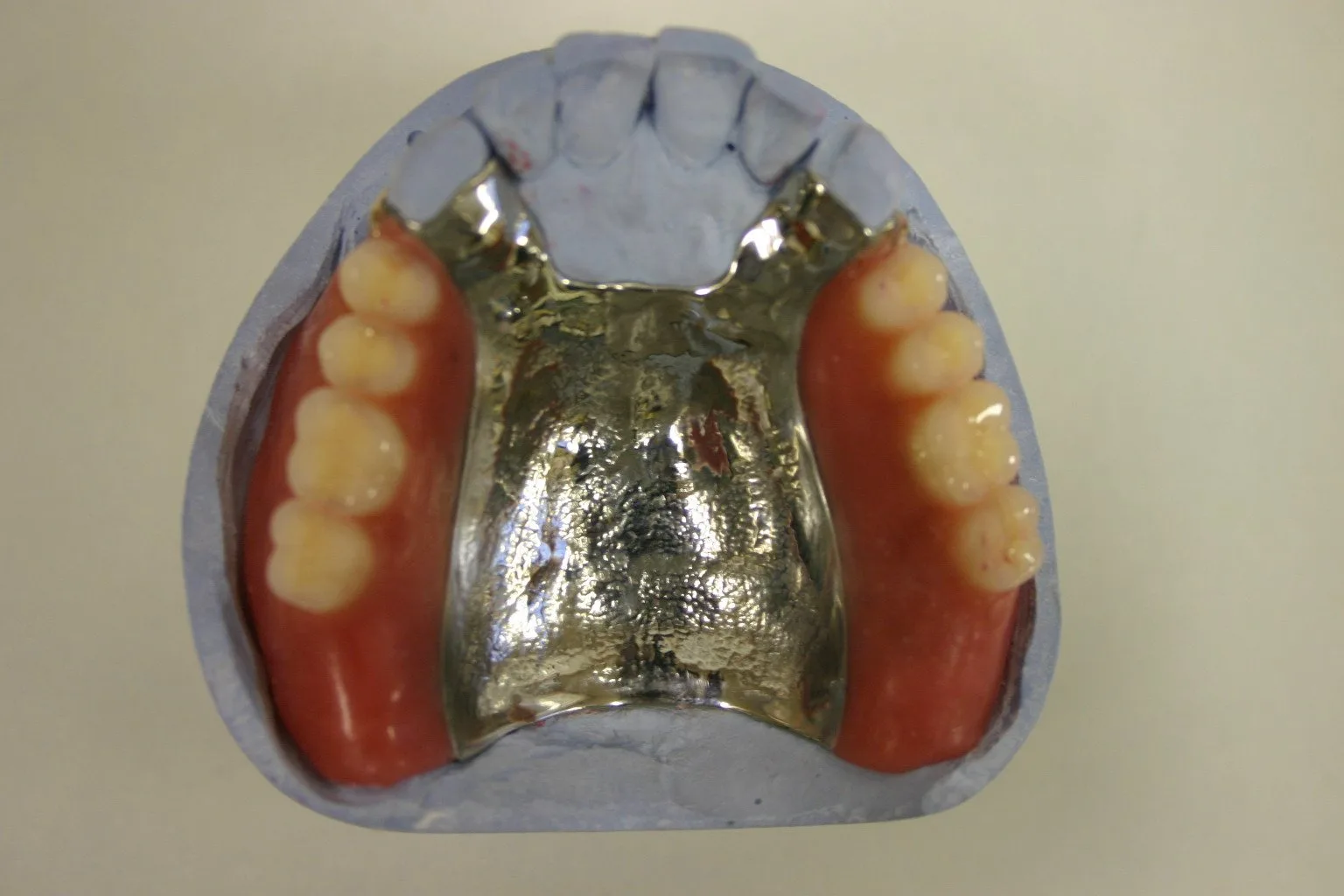
Partial gaps are similar. For someone with a clasp-retained metal framework denture, where the teeth gripped by the clasps have started to wobble, a few implants can ease both the denture and the remaining teeth. You can find the general differences between removable and fixed options on our denture treatment page.
How do two implants hold a denture in place?
In 2002, dentists and researchers who met in Canada wrote in a joint statement that a denture on two implants should be considered the first choice for the toothless lower jaw. Since then this approach has become a standard starting point for older patients in many parts of the world.
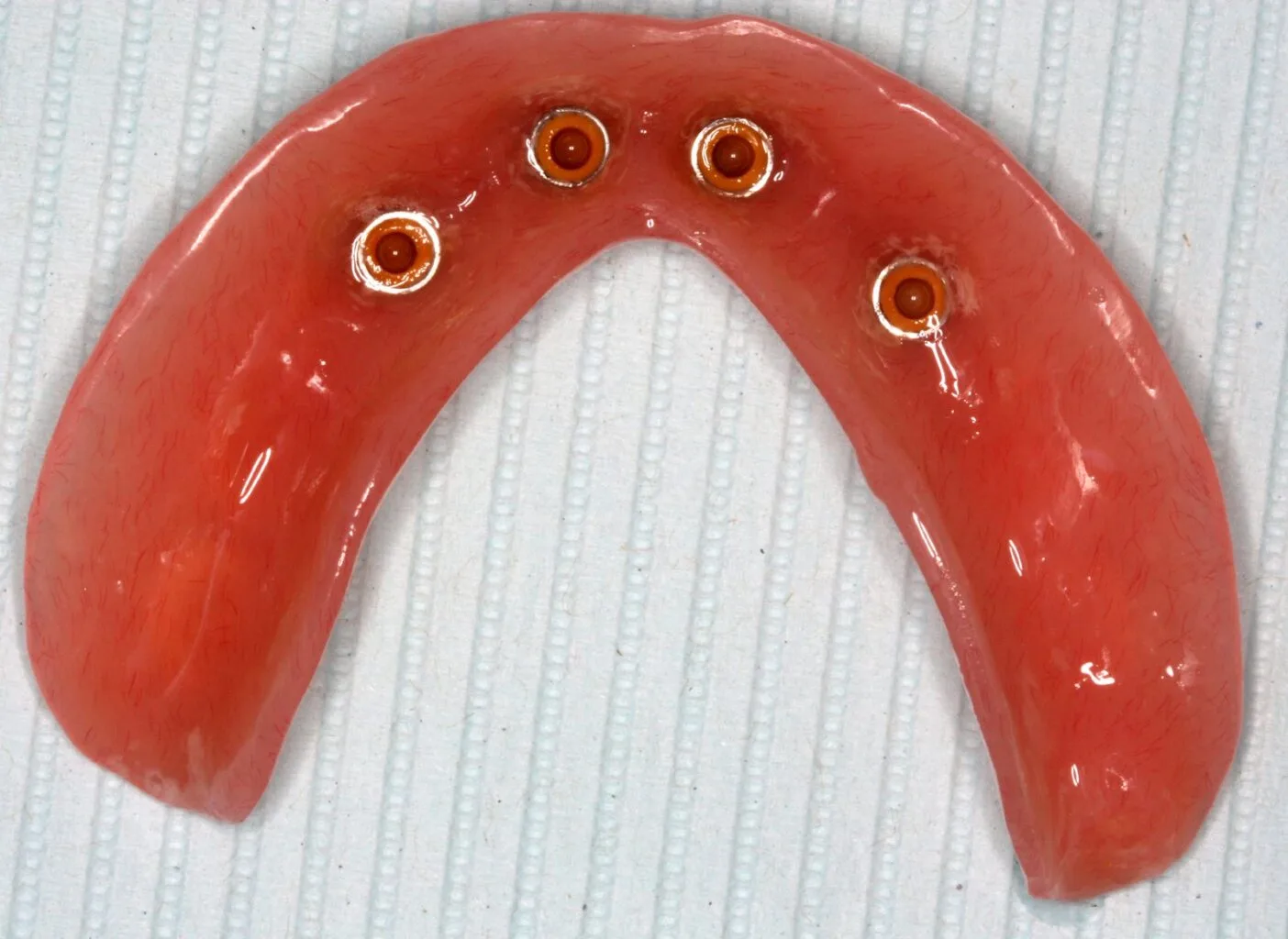
The logic is simple. We place two implants in the front of the lower jaw, usually around where the canine teeth used to be. Once healing is complete, small button-shaped attachments are fitted on top of the implants. Plastic rings that sit on those buttons are placed inside the denture. When you press the denture down, it seats with a soft "click".
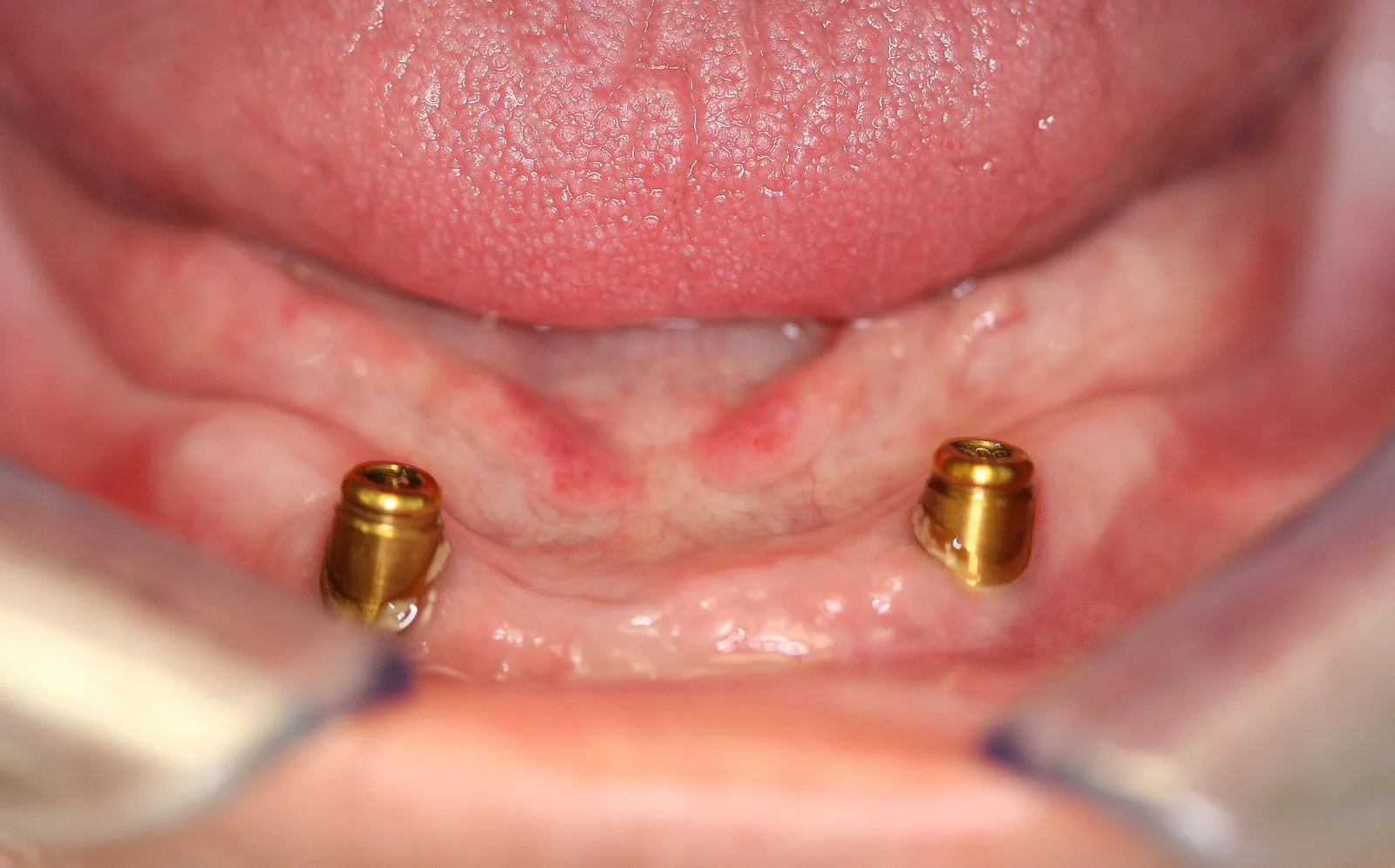
The first time we fit it, many people make the same face. They push the denture with their tongue, and it does not move. They push again. "Is that all?" many have asked. Yes. The surgical side is usually just that, and the rest is getting used to it.
I will mention a few details now so there are no surprises later.
- The existing denture can sometimes be adapted to the attachments, but it is often more sensible to make a new one, since the old one is usually worn out anyway.
- The plastic rings loosen over time and get replaced. That is not a fault, it is maintenance.
- Two implants are usually not enough in the upper jaw. Someone who wants an upper denture without the palate covering needs more implants.
Fixed teeth or a removable implant-supported denture?
Families usually want fixed teeth. That is understandable. But for someone who is seventy-eight, it is not always the right answer.
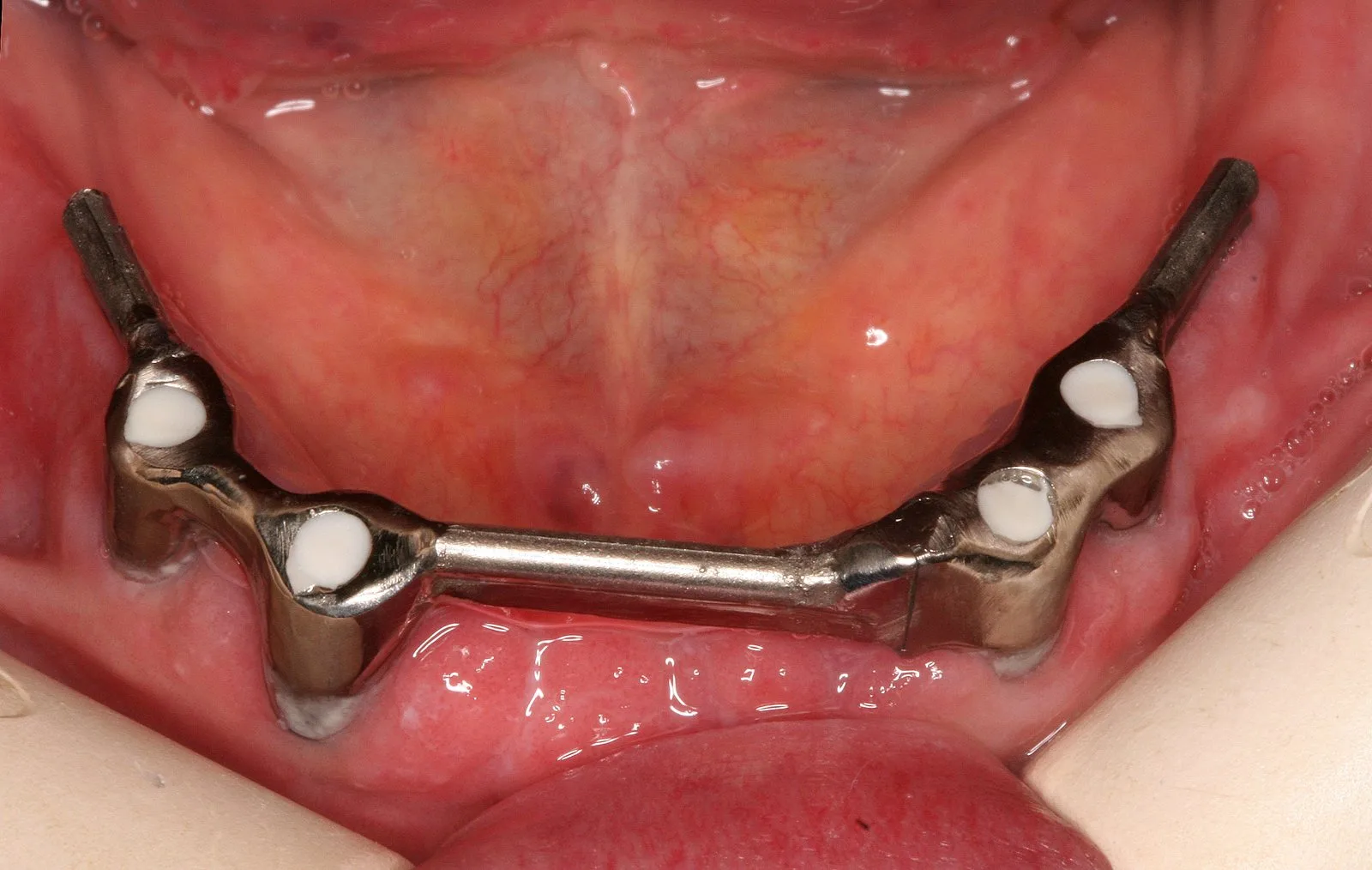
With the fixed option, four or six implants go into the whole jaw and a bridge is screwed on top. Only the dentist can remove it, and the person has to clean underneath and around it carefully every day, much like brushing natural teeth. We have described this method at length on our All-on-4 implant page and in our article on All-on-4 in Turkey. A removable implant-supported denture can be built with fewer implants and sometimes less surgery, and it is much easier to clean.
| Removable implant-supported denture | Fixed implant bridge | |
|---|---|---|
| Implants in the lower jaw | Usually 2, sometimes 4 | Usually 4-6 |
| Can it come out of the mouth | Yes, the person removes it | No, only the dentist can remove it |
| Daily cleaning | The denture is brushed by hand | Interdental brush and water flosser needed under the bridge |
| Bone needed | Can be built with less bone | More bone or angled implants needed |
| Hand tremor or poor eyesight | Easier to manage | Cleaning may become difficult |
Which one suits whom
For someone whose hands are still nimble, who looks closely at their teeth in the mirror every evening and has enough bone, a fixed bridge can be a good option. For someone with a tremor, poor eyesight, or whose care may be handed to someone else within a few years, a removable denture is usually the wiser road. We talk this through together, looking at the person's kitchen, their mirror, their glasses.
Can you get implants with bone loss in the jaw?
Often yes, but the plan changes. We find this out not from a panoramic film but from a 3D scan (CBCT). A flat film alone can mislead.
In younger people with missing bone, building new bone with a bone graft is a route we use often. In later life we try to keep this step as small as possible, because it means another operation, another healing period and a few more months. Instead, short or narrow implants, implants placed at an angle into the bone that is already there, or a removable denture that reduces the number of implants can often take the place of a graft.
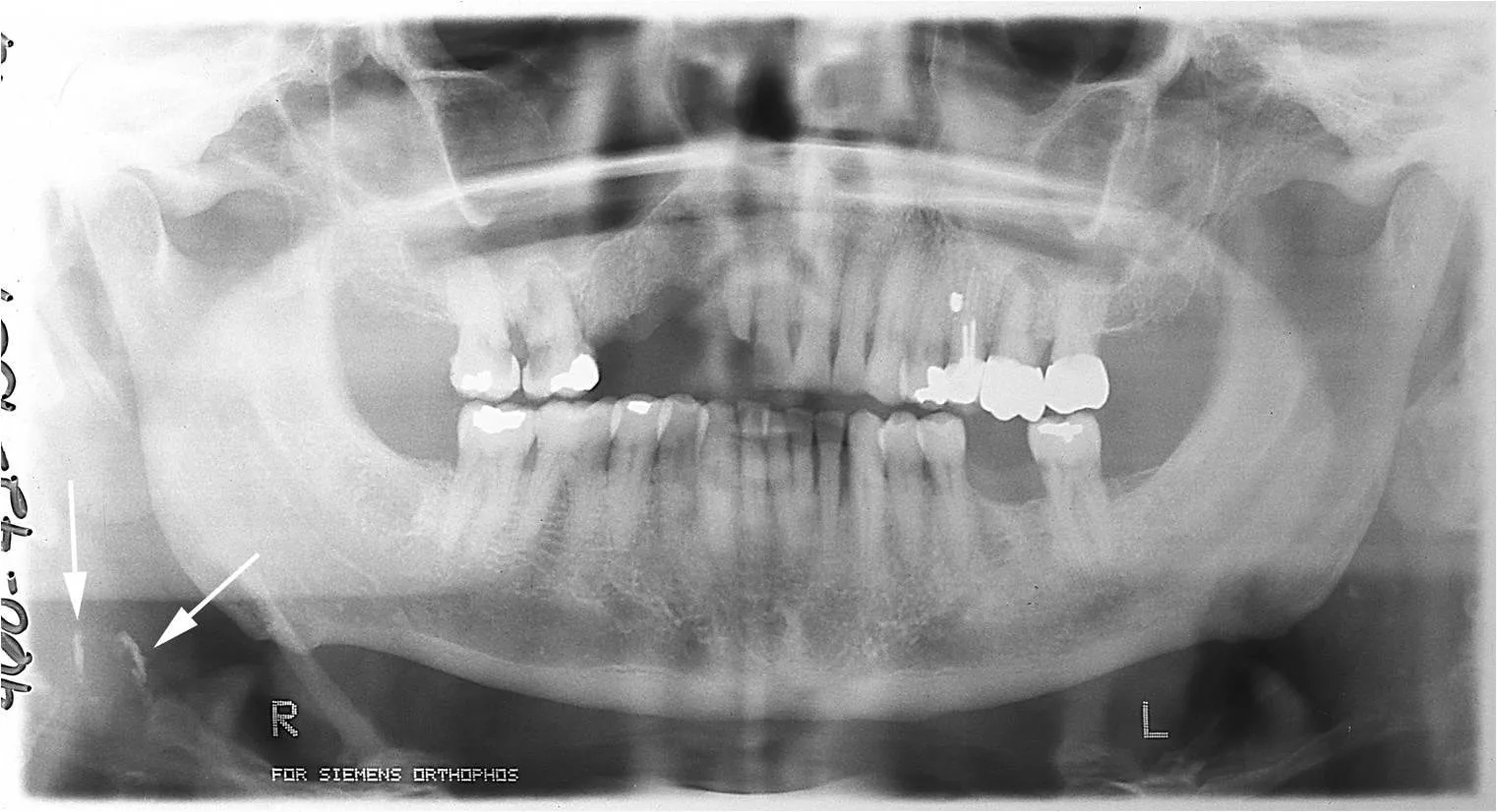
The front of the lower jaw is lucky here too. Even in someone who has worn a denture for years, there is often enough bone for two implants at that spot. That is one reason the two-implant denture is chosen so often in older people.
Can you have implants if you take osteoporosis medication?
Please read this section carefully, because it is the topic people confuse most.
Some medicines used for bone thinning slow down how fast bone renews itself. Some come as weekly or monthly tablets, some are given into a vein once a year, and some are injections under the skin every six months. In people taking them, a wound in the jawbone that does not heal can rarely develop. Medicine calls this medication-related osteonecrosis of the jaw, and the 2022 position paper of the American Association of Oral and Maxillofacial Surgeons explains that this risk varies widely with the type of drug, the dose and how long it has been used.
And in practice? Implants can be placed in most people who take tablets by mouth. The risk is low, but it is not zero. In someone who receives high-dose medication by vein, particularly for cancer treatment, we generally stay away from implants.
One more thing. Do not stop your medicine on your own. Some families stop it because "an implant is coming". What an older person goes through with a broken hip is far heavier than any problem in the jaw. Whether a break is needed is decided by the doctor who prescribed the drug, and we write back and forth with them.
Implants and blood thinners, blood pressure and diabetes medication
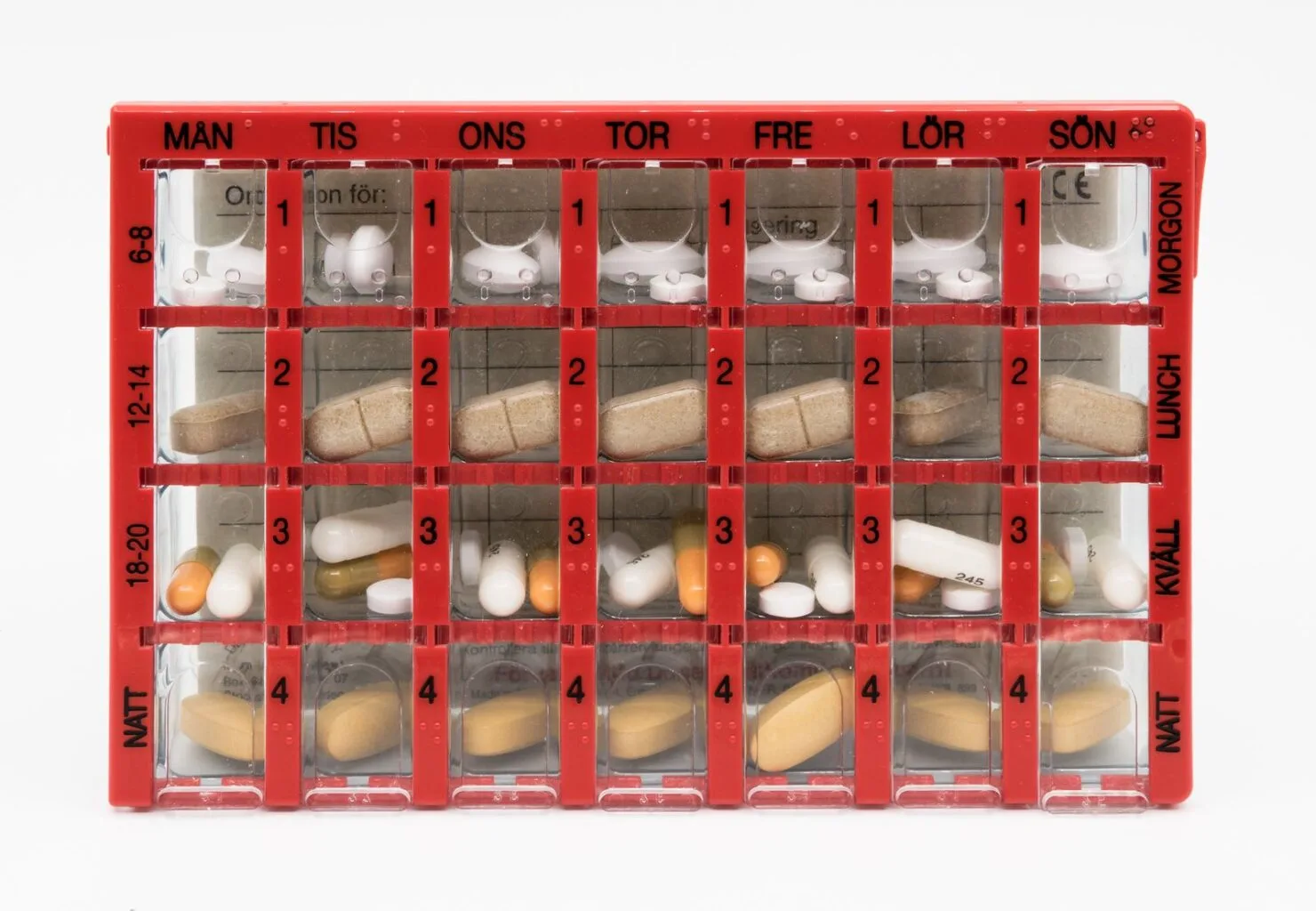
Everybody has a pill box. That is not an obstacle, it is something we need to know about.
Do not stop your blood thinner on your own. I am writing it a second time in case anyone skips the rest of the sentence. For a small operation such as two implants, the medicine is often not stopped, and we control bleeding with local measures. For someone on warfarin we check the blood value on the same day or the day before. With newer blood thinners, adjusting the timing of the dose is sometimes enough. We decide together with your cardiologist.

Blood pressure tablets are never skipped. Someone who missed the morning pill and arrived anxious can reach 180 in the chair, and we do not operate that day. With diabetes, what we really look at is the average over the last three months. Steady blood sugar does not stand in the way of an implant, while uncontrolled sugar makes healing harder. We cover this separately in our article on what to know before getting an implant.
How long is implant surgery for older adults, and are you put to sleep?
Placing two implants in the lower jaw is, for an experienced team, usually a procedure of under an hour. It is done under local anaesthetic, so the person is awake but does not feel the procedure. A little soreness and swelling can follow over the next few days, and ordinary painkillers settle it.
For someone who is anxious, finds it hard to keep their mouth open for long, or needs protection from stress because of their heart rhythm, we can offer conscious sedation with an anaesthetist present. This is not a full general anaesthetic, it puts the person in a deeply relaxed state. You can find the details in our article on how implant surgery is done.
A few small requests for our older patients.
- Book the appointment for the morning, have your breakfast and take your medicines as usual.
- Bring someone with you, and do not drive home.
- Eat soft food for the first few days. Soup, yoghurt, well-cooked vegetables, poached fish.
Planning for ten years from now, who will look after the implants?
This part is a little hard. We still have to talk about it, because once an implant is placed it stays in that mouth for the rest of the person's life, through good days and bad, and we have to think about it according to tomorrow's circumstances, not today's.
Someone of seventy-five who manages on their own today may need another person's help in ten years. A stroke, Parkinson's disease, forgetfulness, these are possibilities. The implant stays in the mouth. For someone living in a care home, or at home with a carer, a fixed bridge that is hard to clean can become a serious source of gum infection.
So when we plan in later life, we ask ourselves this. If this person one day cannot clean their own mouth, could someone else easily take the denture out and wash it? That is the real reason removable dentures are so often preferred for older people. When needed, the attachments can be taken off and the implants left to rest under the gum, and the person can carry on with an ordinary denture without trouble.
Implant care does not change with age, but it gets harder. The area around the attachments should be cleaned every day with a soft brush, and the denture should come out and be washed in the evening. A check-up every six months, and a replacement of the plastic ring when needed. In our article on whether people regret getting implants we described, through real scenes from the clinic, what can happen when check-ups are skipped.
How should adult children living abroad plan for their parents?
A good share of the people who call us live in Germany, the Netherlands or France, with parents in Turkey. Sometimes it is the other way round, with parents who have lived in Germany for years, spend their summers in the village or by the sea after retirement, and want to fit treatment into those few months back home.
The calendar matters. A two-implant denture roughly needs two visits. The first covers the examination, the scan and placing the implants. Then comes a wait of two to four months for the bone to heal, and during that time the existing denture keeps being used with a soft lining. At the second visit the attachments are fitted and the denture is adapted or a new one delivered. In some suitable cases the wait can be shorter, but we do not say so before seeing the scan.

I have one request. Before you come, send the latest panoramic X-ray and a list of the medicines with their doses. If the family has a heart rhythm problem, a blood thinner or a bone-loss medicine, ask the doctor concerned for a short letter. Build a calendar that leaves room for healing, instead of one squeezed into holidays. We described the process in Turkey in general in our dental tourism article, and the planning is done at both our Haliç and Pendik branches.
Every family asks about cost. They are right to. We do not write figures here, because the health advertising regulation does not allow it, and the figure varies a great deal from person to person anyway. The number of implants, the need for a graft, whether the current denture can be reused and whether the result is fixed or removable change the calculation completely. We have explained openly why quotes come out so different in our implant cost article.

At the end of our conversation with the daughter in Stuttgart, I asked her for two things. A photo of her mother's medicine boxes and, if there is one, the latest panoramic film. I promise nobody a holiday table. I cannot. But a table where a denture gets wrapped in a napkin and put in a handbag is a good enough reason to start talking.
Frequently asked questions
What is the age limit for dental implants?
There is no upper age limit for implants. The decision is made not by age but by the jawbone, the medicines taken, general health and whether the person can keep up mouth care. Implants can also be placed in people over eighty.
Can you get dental implants at 80?
For someone of eighty in good general health who takes their medicines regularly, implants are often possible. A commonly chosen plan at this age is to place two implants in the lower jaw and fix the denture onto them. The person's future care needs are taken into account as well.
Is implant surgery risky for elderly people?
As with any surgery, there are risks such as bleeding, infection and delayed healing. A small procedure like two implants in the lower jaw is usually done under local anaesthetic and in under an hour, even in later life. The risks are discussed separately at the examination, based on the person's medicines and general illnesses.
Does the denture change when you get implants for it?
The existing denture can sometimes be adapted to the implant attachments. If the denture is old or no longer fits the bone, making a new one is more sensible. This decision is made at the examination by looking at the condition of the denture.
Can two implants hold a denture?
In the lower jaw, two implants largely stop the denture from lifting when eating and talking. The denture can still be taken out by hand. In the upper jaw, more implants are usually needed.
Can you have implants if you take osteoporosis medication?
In most people who take tablets by mouth, implants can be placed, although there is a low risk of a healing problem in the jawbone. In people who receive high-dose medication by vein, implants are generally avoided. The medicine should never be stopped on the person's own decision.
Can people on blood thinners have dental implants?
Yes. In small implant operations the blood thinner is often not stopped, and bleeding is controlled with local measures. Any change to the medicine is decided together with the doctor who prescribed it.
Can older people with diabetes get dental implants?
People whose blood sugar is steady can have implants. The average blood sugar of the last three months is checked, and because uncontrolled sugar makes healing harder, it is asked to be brought under control first.
Should an implant-supported denture be taken out at night?
Yes, a removable implant-supported denture should be taken out and cleaned every evening, so the gums can rest overnight. The area around the implant attachments should also be brushed with a soft brush.
Send us your parent's latest panoramic X-ray and a list of the medicines they take, and we will talk through a plan with our dentist, based on their condition and not their age. Contact page