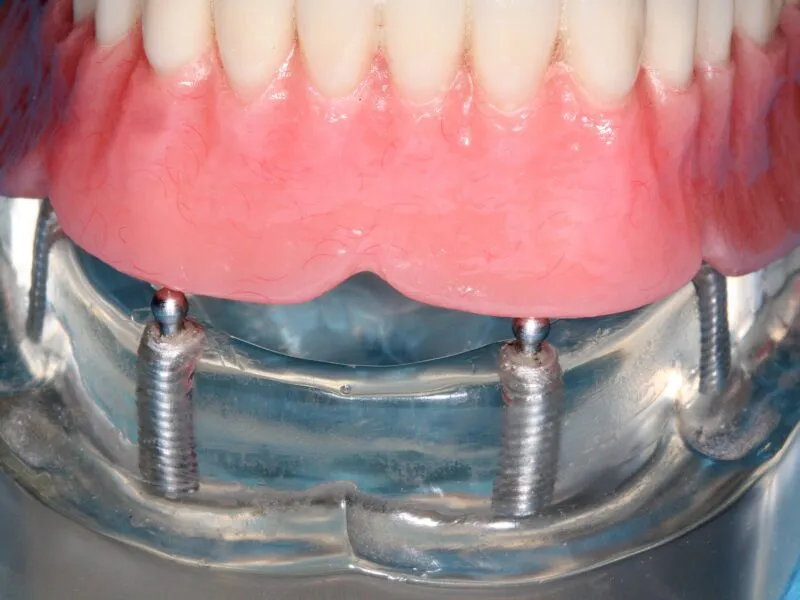
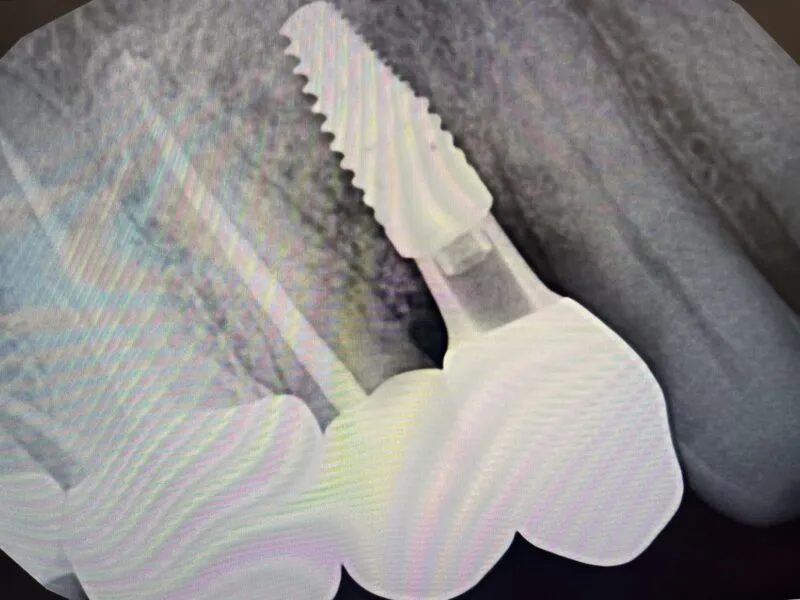
All-on-4 dental implants are a way of treating a jaw with no teeth, or with teeth that cannot be saved, by placing four implants and fitting a single-piece fixed denture that is screwed onto them. In suitable cases, temporary fixed teeth are fitted a short time after surgery, and the final denture is made once the implants have fused with the bone. Whether you are suitable is decided after an examination and a CT scan.
What are All-on-4 dental implants?
All-on-4 is a treatment concept in which four implants carry a single-piece fixed denture in a jaw with no teeth. The two front implants are placed upright and the two back implants are tilted. Tilting them lets the implants pass beside the sinus cavity in the upper jaw, or beside the canal of the nerve that supplies feeling to the lip and chin in the lower jaw, and take support from the denser bone at the front. In many patients this reduces the need for a bone graft, although it does not always remove it.
You do not take the denture out yourself. At check-ups it is removed by the dentist, cleaned and refitted. For the conventional method used when single teeth are missing, see our dental implant treatment page.
Who is suitable for All-on-4?
All-on-4 can be used in adults who have lost all of their teeth, or whose remaining teeth cannot be kept because of advanced gum disease, fractures or large cavities. It is typically considered for:
- People whose removable denture moves, lifts while chewing, or makes them gag so that they cannot wear it
- People who have been without teeth for a long time and have lost bone at the back but still have enough bone at the front
- People who want a fixed denture that does not cover the palate
Age alone is not a barrier. Poorly controlled diabetes, recent radiotherapy to the head and neck, certain intravenous bone medicines and heavy smoking may lead to the treatment being postponed or a different plan being chosen. If the bone is very thin even at the front, a bone graft may be needed first.
All-on-4 or All-on-6: which one is better for me?
If the volume of bone allows six implants, All-on-6 may be preferred; more implants spread the load of the denture over more points. All-on-4 comes into its own when the bone is limited and a graft is to be avoided. Bone in the upper jaw is usually softer, so six implants may be planned for some patients, while in the lower jaw the dense bone at the front is often enough to carry four. The choice is made by looking together at the bone measured on the CT scan, the teeth in the opposite jaw and your bite. We explain the difference between the two methods in detail in our guide to All-on-4 implants in Turkey.
How does All-on-4 treatment work, step by step?
1. Examination, CT scan and planning
An examination of the mouth, a three-dimensional CT scan and, if needed, blood tests are carried out. The position and angle of the implants are planned digitally, and the tooth arrangement and facial proportions of the denture are discussed.
2. The surgical stage
Any necessary extractions are done and four implants are placed. The procedure is carried out under local anaesthesia, which aims to prevent pain during the procedure; sedation can also be planned in suitable cases. The surgical stage for one jaw usually takes 2-3 hours.
3. The temporary fixed denture
If the implants grip firmly enough at the moment they are placed, an impression is taken and temporary fixed teeth are usually fitted within 1-3 days. This approach is called immediate loading. If the grip is not sufficient, the healing period is spent with a temporary removable denture that puts no load on the implants.
4. The final denture
Once the implants have fused with the bone, a new impression is taken, a try-in is done and the final denture is screwed in.
How long does All-on-4 treatment take?
In most patients the treatment is completed in two stages: about a week for the surgery and the temporary teeth, and then a period of a few days again, several months later, for the final denture. The wait in between is for the implants to fuse with the bone.
| Stage | Average time |
|---|---|
| Examination, CT scan, planning | 1 day |
| Extractions and placing the implants | Usually 2-3 hours for one jaw |
| Temporary fixed denture | Usually 1-3 days after surgery |
| Fusion with the bone | Usually 2-6 months, longer if a graft was done |
| Final denture | A few sessions for impressions and try-ins |
Fusion is often quicker in the lower jaw and a little slower in the upper jaw. Your personal timetable is set after the examination and CT scan.
Do I need to travel more than once for All-on-4?
Most international patients plan two stays. The first, about a week, covers the examination, the CT scan, any extractions, implant surgery and the temporary fixed teeth. You then go home while the implants fuse with the bone, which usually takes 2-6 months. The second stay, of a few days, is for the final impressions, try-ins and fitting of the final denture. Photos and an existing panoramic X-ray or CT scan can be sent by WhatsApp for a preliminary assessment before you travel, but the final plan is only made after the in-person examination. Check-ups after you return home can be done with a local dentist, with remote contact with our clinic in between.
What should I do after All-on-4 treatment?
- In the first weeks, soft and lukewarm foods are eaten. While you have the temporary denture, avoid demanding foods such as nuts in shells, meat on the bone and sticky sweets.
- The underside of the denture and the area around the implants are cleaned every day. A water flosser and interdental brushes make it easier to reach these areas.
- Smoking slows healing around the implants. It is advised that you do not smoke at all, at least during the healing period.
- In the first year, check-ups are done every 3-6 months. When it is thought necessary, the denture is removed for a professional clean.
- If you clench your teeth at night, a night guard may be recommended to protect the denture.
What are the risks and possible complications of All-on-4?
All-on-4 is a surgical treatment and, as with any surgery, it carries risks. Swelling, bruising and tenderness are expected in the first days. Less common problems include:
- Infection: It can develop at the surgical site early on, or around the implant (peri-implantitis) over the years.
- An implant that does not fuse: If one of the four implants does not integrate with the bone, the plan is redone and an additional implant may be needed.
- Nerve and sinus: Numbness of the lip may occur in the lower jaw, and a relationship with the sinus in the upper jaw. Planning tilted implants aims to keep away from these areas.
- Denture problems: A screw may loosen or the temporary denture may fracture; most are put right at a check-up.
Smoking, poorly controlled diabetes and poor oral hygiene all increase each of these risks.
Where can I be examined in Istanbul?
All-on-4 planning starts with an examination and a CT scan; suitability, the need for a graft and the option of a temporary denture become clear at this stage. You can come to our Haliç clinic or our Pendik clinic for an examination.
Sources
The results of any surgical or interventional procedure may vary from person to person. It is recommended that you obtain detailed advice from your physician before the procedure. The information on this page is for general informational purposes; the treatment suitable for you is determined after an examination.