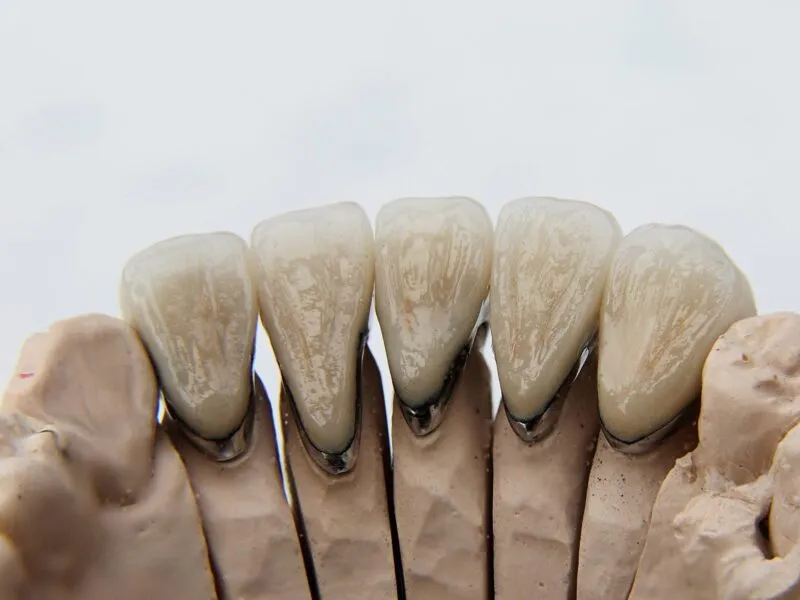
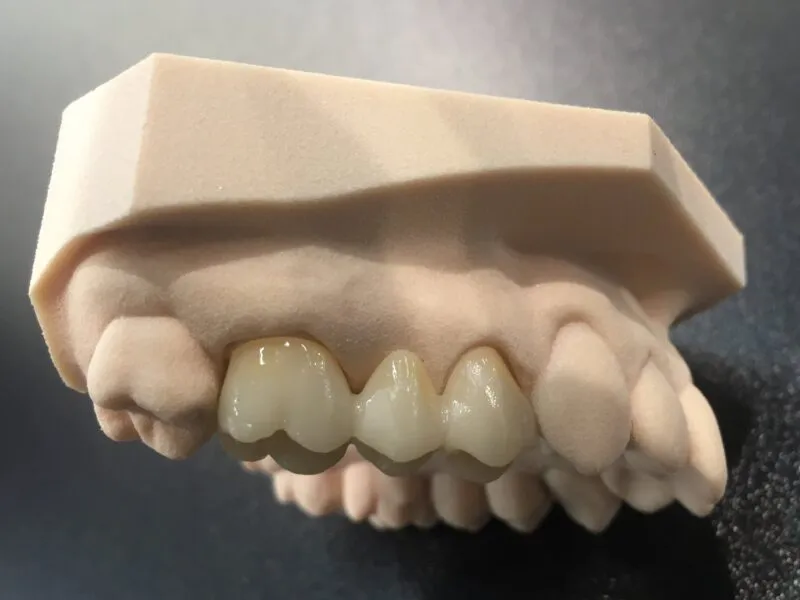
Porcelain laminate veneers are thin ceramic shells bonded to the front surface of the teeth, in most cases 0.3-0.7 mm thick. They are used to correct colour, shape, small gaps and mild irregularities in position. Composite veneers are also an option; which one is suitable is decided at the examination, once the structure of your teeth and your bite have been assessed.
What are laminate veneers?
A laminate veneer is a thin shell that, rather than wrapping the whole tooth, covers only the visible front surface and, where needed, the biting edge, and is attached to the tooth by bonding. Porcelain veneers are made in a laboratory from feldspathic porcelain or glass ceramic, while composite veneers are usually shaped directly in the mouth with filling material. Bonding makes its strongest connection on tooth enamel, so the aim is to keep the preparation within the enamel as far as possible.
Who can have porcelain veneers?
Laminate veneers are used to correct colour and shape problems on front teeth whose structure is largely sound. Common situations are:
- Stains that have not responded enough to whitening
- Fractured, worn or short biting edges
- Gaps between the front teeth (diastema)
- Differences in length and shape, and mild crowding
In marked crowding, correcting with veneers can need a lot of reduction, so clear aligners or orthodontics are considered first. Severe clenching, too little enamel, teeth with large fillings, active decay and untreated gum disease may make laminates unsuitable. For teeth with large fillings, a full crown may be the better choice.
Are teeth cut down for veneers, and how much?
For a porcelain laminate, 0.3-0.7 mm is usually removed from the front of the tooth; this is clearly less than the reduction needed for a full crown. The position of the tooth, how much of the colour has to be masked and the planned shape change this amount. With small teeth or when closing a gap, it is sometimes possible to place veneers with very little or no reduction, but then the tooth can look thicker. Enamel that is removed does not grow back, so a tooth that has had a laminate will always need some form of covering from then on. Our article that covers this in more detail: Are teeth cut down for a Hollywood smile?
How many visits do porcelain veneers take?
Porcelain laminates are completed in 2-3 sessions in most cases, about 1-2 weeks including laboratory time.
- Analysis: Photographs, a digital impression and a bite assessment are done, and your expectations of colour and shape are discussed.
- Trial (mock-up): The planned shape is placed over your teeth in a temporary material, and you look together at how it appears when you speak and smile.
- Preparation and impression: The teeth are prepared to the planned amount, an impression is taken and temporary veneers are made.
- Try-in and bonding: The laminates are tried in the mouth with a try-in paste for colour, then bonded one by one with the adhesive technique, and the bite is checked.
The time is longer if whitening, gum treatment or orthodontics is needed first. The exact plan is set after the examination.
Do I need to travel more than once for veneers?
For most international patients, porcelain veneers can be completed in one stay of about 1-2 weeks, in 2-4 sessions with laboratory time in between: analysis and trial, preparation and impression, then try-in and bonding. If whitening, gum treatment or orthodontics is needed first, a second visit may be advised. Photos and an existing panoramic X-ray or CT scan can be sent by WhatsApp for a preliminary assessment before you travel, but the final plan is only made after the in-person examination. Check-ups after you return home can be done with a local dentist, with remote contact with our clinic in between.
Porcelain veneers or composite veneers?
Porcelain laminates keep their colour and surface for longer, while composite veneers can be done with less reduction and mostly in a single session.
| Feature | Porcelain laminate | Composite veneer | Full crown |
|---|---|---|---|
| Tooth reduction | Little | Very little or none | All surfaces of the tooth |
| Sessions | 2-3 | Mostly 1 | 2-3 |
| Colour change | Little | May stain over time | Little |
| If it breaks | Usually replaced | Can often be repaired in the mouth | Usually replaced |
| Suitable when | Front teeth with sound structure | Small changes in shape and gaps | Teeth with large fillings or weak teeth |
For full crown options, see the zirconia crowns page.
How long do veneers last, and what does it depend on?
How long a laminate veneer lasts varies from person to person; porcelain laminates bonded to enamel and looked after well can be used for many years, but it would not be right to give a fixed figure. The things that affect it most are clenching and grinding, whether the bite puts too much load on the front teeth, habits such as biting pens or nails, oral hygiene and gum health. Composite veneers generally need polishing and renewing more often.
What are the risks and disadvantages of veneers?
The main disadvantage of laminate veneers is that, however little is removed, it cannot be reversed. Other points to know:
- Sensitivity: There may be sensitivity to hot and cold for a few days after preparation.
- Chipping and debonding: Biting on hard objects or clenching can cause a laminate to fracture or come off.
- Staining at the edge: Over the years, a thin line of staining may appear at the border between the laminate and the tooth.
- Colour stability: Porcelain does not lighten with whitening. If your other teeth are to be whitened as well, this is done before the laminates.
- Gum changes: If the gum recedes, the edge of the laminate can become visible.
- Getting used to them: In the first days, some sounds and your bite may feel different; this usually passes quickly.
How do I look after veneers?
Laminate veneers should be brushed twice a day like natural teeth, and the area between them cleaned with floss every day. Whitening toothpastes with abrasive ingredients are not recommended, as they can dull the surface over time. Avoid habits such as opening bottles with your front teeth, biting thread or cracking seeds. If you clench, a night guard protects the laminates. At check-ups twice a year, the edges, gums and bite are assessed.
Where can I be examined in Istanbul?
Planning veneers starts with an examination, photo analysis and a digital impression at our Haliç (Hasköy, Beyoğlu) and Pendik clinics. At the examination, we discuss whether your teeth are suitable for laminates, how much reduction would be needed, and whether less invasive options such as whitening or orthodontics would be enough. For clinic details, see the Haliç clinic page.
Sources
- ADA MouthHealthy: Veneers
- American Dental Association: Materials for Indirect Restorations
- NHS: Teeth grinding (bruxism)
The results of any surgical or interventional procedure may vary from person to person. It is recommended that you obtain detailed advice from your physician before the procedure. The information on this page is for general informational purposes; the treatment suitable for you is determined after an examination.